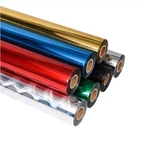
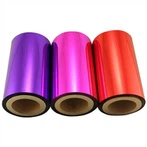
With the development and expansion of the printing factory industry and the needs of applications in various industries, the application of cold bronzing technology in the commercial sales market has received greater demand and development. The application of cold bronzing technology is divided into two types: DryLamination and WetLamination. The key to the production process is UV adhesive and special electrochemical metal foil, which is not as simple as the production technology of electrochemical foil coated with hot melt adhesive.
DryLamination
The initial cold stamping technology application is in the form of dry cold stamping. The application of dry cold stamping technology is to process the image on the substrate and use a UV lamp to dry and solidify the UV glue on the coated substrate to make the image sticky. , immediately turn the foil onto the sticky image with the pinch roller and remove the unnecessary foil. The key process steps are as follows:
1. Printing cationic UV adhesives on web-based raw materials.
2. Do a good job of curing the UV adhesive.
3. The cold stamping foil is combined with the printing material by means of a pressure roller.
4. Separate unnecessary hot stamping foil from the substrate, leaving only the desired hot stamping graphics on the adhesive-coated areas.
When dry cold stamping is used, the curing of the UV adhesive can be done quickly, but it cannot be completely cured. It is necessary to ensure that it still has the corresponding viscosity after curing so that it can be effectively bonded with the hot stamping foil.
WetLamination
The form of wet cold stamping is to print the image on the substrate and coat the UV adhesive, then use the pressure roller to attach the cold foil to the substrate, and use a UV lamp to dry the UV glue on the substrate to make the image sticky. Remove unnecessary foil. The key process method steps are as follows:
1. Printing of free-radical UV adhesives on web substrates.
2. Apply cold stamping foil to the substrate section.
3. Do a good job of curing the free-radical UV adhesive, because the adhesive is sandwiched between the cold stamping foil and the printing village at this moment, and the UV light must pass through the hot stamping foil to reach the adhesive layer.
4. The hot stamping foil is separated from the printing material, and the hot stamping graphic is formed on the printing material. Because the wet cold stamping process uses free-radical UV adhesive to replace the traditional cationic UV adhesive; therefore, the initial adhesion of the UV adhesive is stronger, and it can be sticky again after curing; and the hot stamping foil plating The metal layer should have corresponding light transmittance to ensure that the UV light can pass through and cause the curing reaction of the UV adhesive. Wet cold stamping technology can be applied to the printing press.